

Warlimpirrnga Tjapaltjarri Australian Aboriginal Art.The Last Tribe
Enquire
200 cm x 120 cm
Warlimpirrnga Tjapaltjarri
One of Australia’s most acclaimed Indigenous artists, hails from the Pintupi people of the Gibson and Great Sandy Desert regions.
Born in the late 1950s, Warlimpirrnga and his family, including his sister Yukultji Napangati, lived a traditional nomadic life as hunter-gatherers with minimal contact with outsiders until 1984. His artwork is a vivid portrayal of the desert landscape, infused with cultural significance and visual energy. Warlimpirrnga’s paintings are characterized by undulating, optical patterns that shimmer and swirl like a mirage. These mesmerizing effects are created by meticulously painted lines and dots, symbolizing the ancient stories of his people and the formation of the desert they call home.
Warlimpirrnga’s work has earned international recognition, with exhibitions at prestigious venues like the Menil Collection (Houston, 2019) and the Nevada Museum of Art (2015). His art has been showcased at Documenta 13 (Kassel, 2012) and in major galleries worldwide, including The Art Gallery of New South Wales, The Harvard Art Museums, The National Gallery of Victoria, and The Toledo Museum of Art.
As a member of the renowned Pintupi Nine, Warlimpirrnga Tjapaltjarri, alongside artists like Walala Tjapaltjarri, Thomas Tjapaltjarri, and Yukultji Napangati, has played a crucial role in shaping the Australian Indigenous art movement, producing some of the most sought-after and impactful artworks of contemporary Aboriginal art.
The Australian

Courtesy of The Australian.
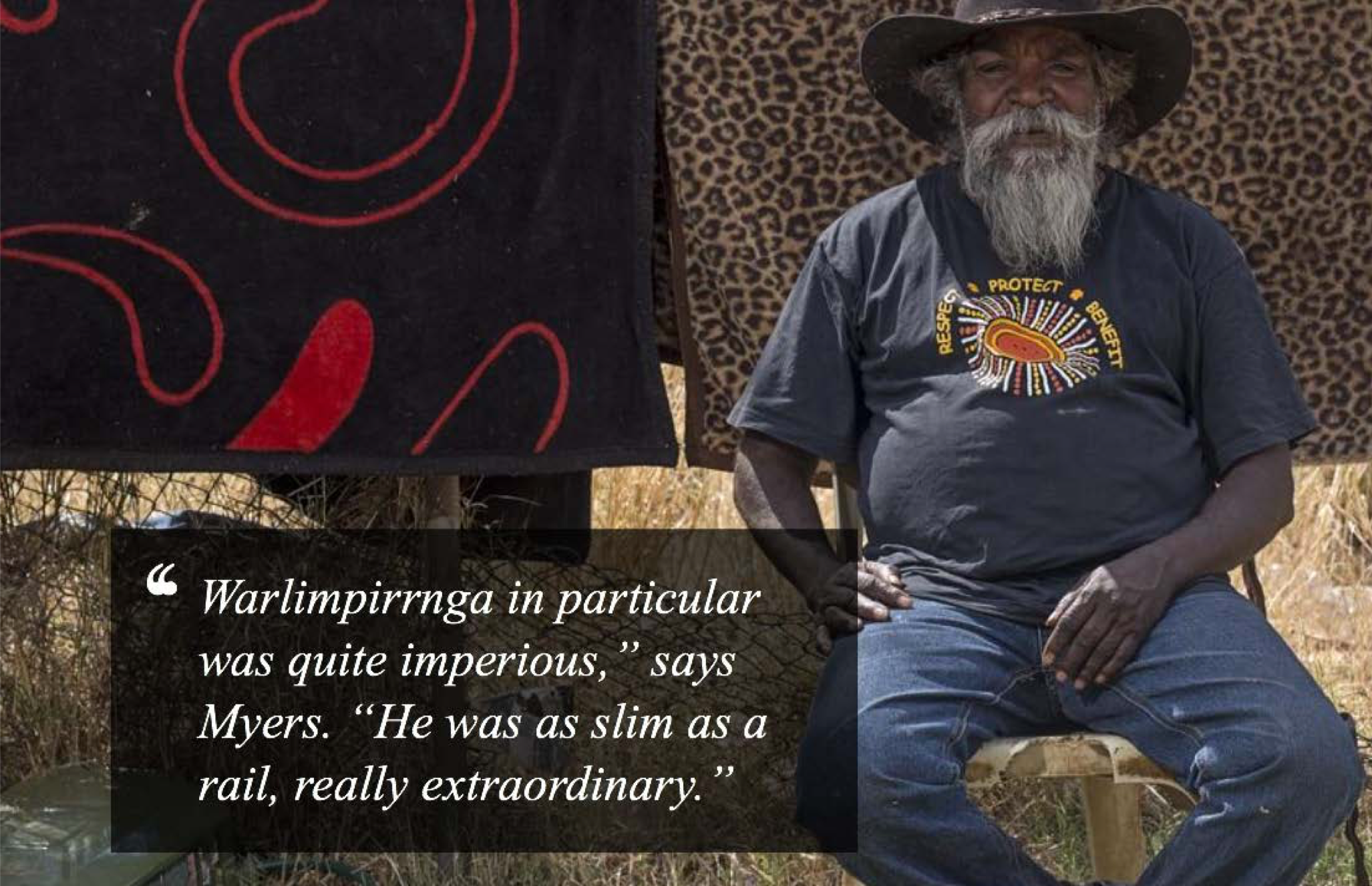
The two naked men were Warlimpirrnga Tjapaltjarri and his half-brother, Piyiti, the principal hunters in a nine- strong nomadic group that roamed a relatively small area south of Lake Mackay. The others in the group were Warlimpirrnga’s mother, Papalya Nangala, his sister Takariya, his aunt Nanu and her three adolescent children – Yalti,Yukultji and their brotherTamayinya – along with a 14-year-old male cousin, Walala Tjapaltjarri. Warlimpirrnga and Piyiti must surely have been a fearsome sight in the desert in 1984, as photographs later attested – two lean, bearded hunters in their mid-20s, their long hair tied back, clutching perfectly straightened, four-metre-long spears.
Today Warlimpirrnga is a grizzled, grey-bearded 50-something with a generous pot-belly who lives in one of Kiwirrkurra’s unprepossessing houses, surrounded by his extended family of children, grandchildren and great-grand-children. A wily storyteller whose recollections are not always to be taken literally, his story first became widely known via the 2000 television series Australia: Beyond The Fatal Shore,presented by Robert Hughes. An inveterate traveller and artist of some stature, he was sitting on a kitchen chair in his front yard one recent morning, clutching a two-litre bottle of Diet Coke and recalling younger days when he could launch a spear from his lankurru (woomera) with such deadly force that it would bring down a camel. “Yes, I speared a camel – young one,” he says through an interpreter. “Cut off that meat with an axe made from stone. Good feed – all my family ate that camel.”